
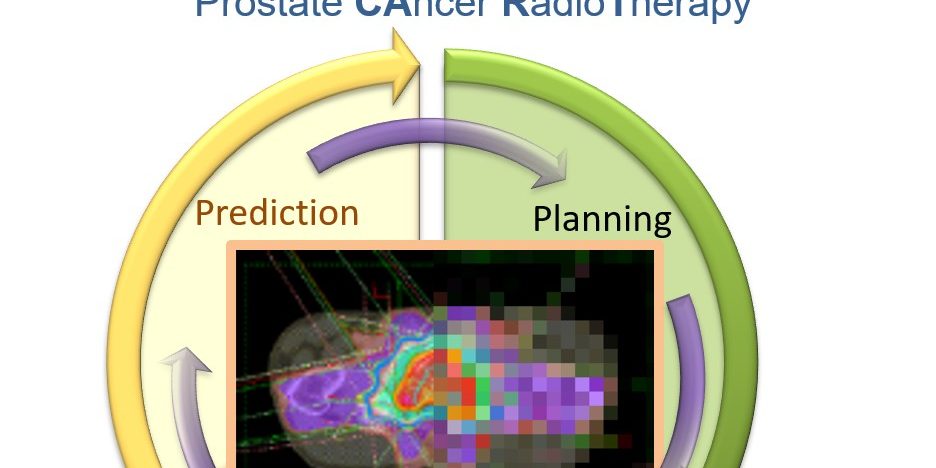
Digital Twin for Personalized Care and Planning in Prostate Cancer Radiotherapy
Project Lead: Oscar Acosta
Coordinating institution: University of Rennes
Prostate cancer, mechanistic model, MRI-Linac, radiotherapy, multiscale data, histopathology, transcriptomics, radiomics, recurrence, oncology
TwinCaRT creates a dynamic patient specific Digital Twin designed to simulate prostate cancer growth and predict response to radiotherapy.
By integrating multi-omic data with advanced mechanistic modeling, we aim to:
- Model Tumor Dynamics: Track how the tumor grows and evolves within a virtual environment.
- Simulate Radiotherapy Response: Predict how cancer cells will react to radiation before the first dose is ever delivered.
- Devise Personalized Treatments: Use in silico simulations to generate spatial distributions of surviving cells, allowing clinicians to optimize and adapt therapy for every individual.
TwinCaRT brings together 8 teams with complementary expertise in Medical Physics, Artificial Intelligence, Medical Imaging, Radiation Oncology, and Industrial Transfer.
The project leverages the power of the first two French centers equipped with the Elekta Unity MR-Linac (1.5T MRI). These unique platforms allow for high-precision adaptive radiotherapy, providing the real-world data necessary to fuel and validate our virtual models and devise personalized treatments.
| Laboratory / department / team | Supervisory institution(s) |
| LTSI UMR 1099, Eq IMPACT (coord.) | Université de Rennes, Inserm |
| LaTIM UMR 1101, Eq ACTION | Université Brest Bretagne Occidentale, Inserm |
| CREATIS UMR 1294 Eq MAGICS | INSA, Inserm, CNRS, Univ Lyon 1 |
| Centre Eugène Marquis | Ligue Cancer Rennes, Fondation Region Ouest Ligue Cancer |
| Direction de la recherche en santé HCL | HCL, Lyon |
| EURECOM | Ecole d’ingénieurs, Campus Sophia Antipolis |
| ICO-DSRT – Unité de recherche | Institut de cancérologie de l’Ouest |
| DASSAULT SYSTEMES |