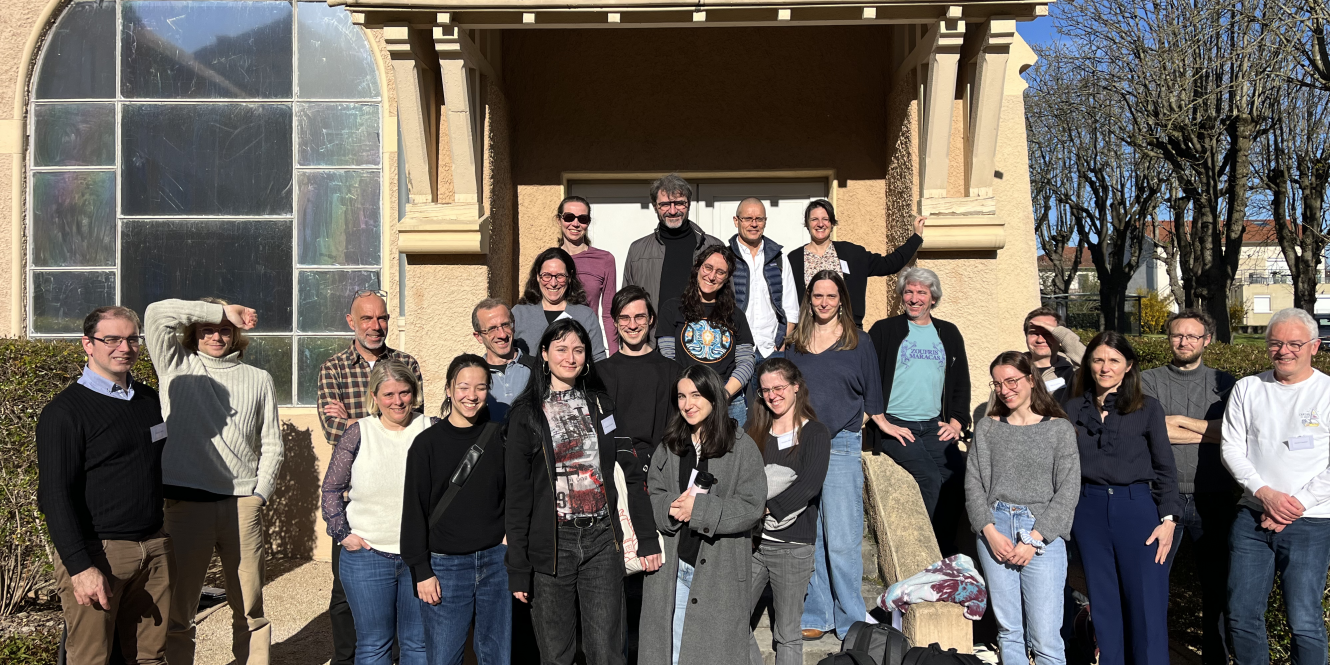
During the week of 16 March, the ‘Methods and Models for the Integration of Multimodal and Multiscale Data’ (M4DI) consortium gathered for its annual retreat at the Domaine de Lyon Saint-Joseph.
The M4DI project
The M4DI project aims to develop innovative methods for integrating multimodal and multiscale biomedical data. This challenge arises in a context marked by the massive production of data, notably from omics approaches and clinical databases. These data open up unprecedented opportunities to improve our understanding of diseases, yet their exploitation remains difficult because of their heterogeneity, their fragmented nature, and the imbalance between the limited number of available patients and the very large number of variables to be analysed.
Led by interdisciplinary teams, M4DI aims to propose new methodologies capable of advancing healthcare and the prediction of disease onset by aiding diagnosis and prognosis, providing clinical decision-making tools, and/or identifying new therapeutic pathways.
To this end, the M4DI project is based on an original approach that places the recruited PhD students at the heart of the project’s dynamics.
The retreat
The project is designed to be highly multidisciplinary, presenting real challenges in terms of coordinating and facilitating collaboration among the teams involved. As such, the 2026 retreat introduced tools drawn from collective intelligence methodologies. This opening session of the retreat served both as a training session and as a special opportunity to strengthen cohesion and establish rules of conduct for the rest of the week.
The second part of the retreat emphasised the collaborative aspect through the presentation of work in progress by the various consortium teams, adopting an approach of co-construction, collective immersion and constructive discussions on the future stages of each project component.
The third session provided an opportunity to reach out beyond the consortium, notably through two keynote presentations by researchers from outside M4DI:
- Mathilde Paris (IGFL), on modelling applied to the study of regeneration in unconventional models,
- Franck Picard (AI4scMED), who gave a very accessible presentation on the biostatistical methodologies of separation and visualisation derived from single-cell data, which are necessary for multimodal analysis.
The second half of the week was devoted more to the consortium’s PhD students. This year, the project opened up this second half to around ten PhD students from other PEPR SN projects (e.g. ShareFAIR, NEUROVASC, SMATCH). This time was organised around training sessions on life after the PhD and how to present research effectively, scientific discussion sessions known as Helpathons, and a World Café to offer advice on topics such as writing scientific articles or creating posters.
It was a week rich in knowledge-sharing, illustrating the transdisciplinary nature of digital health, but also providing an opportunity to reflect on the tools, methods and role of the researcher, who is sometimes also a teacher or doctor, in the field of artificial intelligence.
The project is designed to be highly multidisciplinary, presenting real challenges in terms of coordinating and facilitating collaboration among the teams involved. As such, the 2026 retreat introduced tools drawn from collective intelligence methodologies. This opening session of the retreat served both as a training session and as a special opportunity to strengthen cohesion and establish rules of conduct for the rest of the week.
The second part of the retreat emphasised the collaborative aspect through the presentation of work in progress by the various consortium teams, adopting an approach of co-construction, collective immersion and constructive discussions on the future stages of each project component.
The third session provided an opportunity to reach out beyond the consortium, notably through two keynote presentations by researchers from outside M4DI:
- Mathilde Paris (IGFL), on modelling applied to the study of regeneration in unconventional models,
- Franck Picard (AI4scMED), who gave a very accessible presentation on the biostatistical methodologies of separation and visualisation derived from single-cell data, which are necessary for multimodal analysis.
The second half of the week was devoted more to the consortium’s PhD students. This year, the project opened up this second half to around ten PhD students from other PEPR SN projects (e.g. ShareFAIR, NEUROVASC, SMATCH). This time was organised around training sessions on life after the PhD and how to present research effectively, scientific discussion sessions known as Helpathons, and a World Café to offer advice on topics such as writing scientific articles or creating posters.
It was a week rich in knowledge-sharing, illustrating the transdisciplinary nature of digital health, but also providing an opportunity to reflect on the tools, methods and role of the researcher, who is sometimes also a teacher or doctor, in the field of artificial intelligence.